
Protective orders
You know you need protection, but the forums keep asking the same thing: is what I have enough? Here is what the court actually looks at, how to set it out, and what happens from the day you apply to the return hearing.
The short answer
What evidence do I need for a non-molestation order? There is no checklist and no minimum. Your own signed witness statement is evidence, and it is the heart of every application on form FL401. Messages, photos, medical notes, police reference numbers and letters from support services all help, but you do not need a police report or recent violence. The court looks at all the circumstances, including the need to protect your health, safety and well-being and that of any child.
"What evidence do I need for a non-molestation order?" is one of the most searched questions I see. Forum replies mostly share personal stories, which leaves you guessing. So let me set out what the law says, what the court looks at and how to present it calmly, with a typical story along the way.
If you are in danger right now, stop reading and call 999. If you cannot speak, call 999 and press 55 when asked. There is more support on our Keeping You Safe page.
Non-molestation order or occupation order: what is the difference?
Both are injunctions under Part 4 of the Family Law Act 1996, and you apply for either or both on the same form, form FL401. GOV.UK says there are no court fees for applying.
| Non-molestation order | Occupation order | |
|---|---|---|
| What it does | Stops a person from molesting you or a relevant child. It can cover molestation in general, particular acts, or both, such as contacting you or coming near your home. | Decides who can live in the home, or part of it, and can require someone to leave or keep away from a defined area around it. |
| Who can apply | Someone "associated" with the other person: a spouse, partner or ex, someone you live or lived with, a close relative, the other parent of your child. | Depends on your rights in the home, for example owning or renting it, or being married to the owner. |
| What the court weighs | All the circumstances, including the need to secure your health, safety and well-being and any relevant child's (section 42(5)). | Housing needs and resources, finances, the effect on everyone's health, safety or well-being, and conduct, plus a "balance of harm" test (section 33). |
| If it is broken | A criminal offence. You can call the police. | The court can attach a power of arrest. You can call the police. |
What evidence do I need for a non-molestation order if there has been no recent violence?
Violence is not required. GOV.UK describes a non-molestation order as protection from being harmed or threatened, and from abuse or harassment. Under section 42 of the Family Law Act 1996 the court has regard to all the circumstances, including the need to secure the health, safety and well-being of you and any relevant child. Threats, constant messages, turning up at your door, controlling behaviour, damaging your things and frightening you in front of the children can all be relevant.
The Family Procedure Rules, rule 10.2, say every application must be supported by a witness statement. That statement is evidence in itself. Everything else supports it. Useful supporting evidence includes:
- Messages, emails, voicemails and call logs, screenshotted with the date, time and sender visible
- Photos of injuries or damage, with the date taken
- Police reference numbers or crime numbers, even if nobody was charged
- GP, hospital, health visitor or counselling notes where you told someone what was happening
- Letters from support services, such as an IDVA or a domestic abuse charity
- People who saw or heard things: a neighbour, a friend, a family member
- A diary or log you kept at the time
Do not worry if you only have some of these. What helps most is detail: dates, what was said or done, and how it affected you and the children.
Do past incidents still count?
Yes. The Act sets no cut off date for incidents, and the court looks at all the circumstances. Older incidents can show a pattern, and patterns matter, especially with controlling behaviour.
But the court is deciding whether you need protection now. So link the past to the present. Explain what has happened recently, even if it is "only" messages, being followed, or threats passed on through others, and why, given the history, it frightens you.
How to set out your evidence: step by step
- Use the template, or follow its guidanceGOV.UK offers a supporting witness statement template with form FL401. If you write your own, you must still read the template's guidance.
- Start with the basicsWho you are, your relationship with the other person, the children, and where everyone lives now.
- Set out the incidents in date orderNumber each paragraph. For each incident: the date (or best estimate), where, what was said or done, who saw it, and how it affected you or the children. Keep the worst and most recent incidents clear and specific.
- Explain why you need protection nowWhat has happened recently, what you fear will happen next, and why.
- Label your exhibitsNumber each screenshot, photo or letter and refer to it in the statement, for example "Exhibit 3, messages of 2 November".
- Say exactly what you are asking forFor example, not to contact you except through a solicitor or a named app about the children, not to come within a set distance of your home.
- Ask for an urgent order if you need oneIf you are asking the court to act before the other person is told, say why in the statement (rule 10.2(4)).
- Sign the statement of truthGOV.UK gives the exact words: "I understand that proceedings for contempt of court may be brought against anyone who makes, or causes to be made, a false statement in a document verified by a statement of truth without an honest belief in its truth. I believe that the facts stated in this form and any continuation sheets are true." Sign and date it.
- Keep your address private if you need toFill in form C8 so your address and phone number are not shared.
GOV.UK also says you can prepare an application online through the RCJ Citizens Advice CourtNav service, and RCJ Advice can complete the forms with you. Check whether you can get legal aid too: injunctions for domestic abuse are within the scope of legal aid. Our guide to legal aid for family court explains the test.
Can the court make my ex leave the home?
Yes, through an occupation order, but the court treats this seriously because it affects where someone lives. Under section 33, where you are entitled to occupy the home (for example you own or rent it), an order can require the other person to leave, regulate who lives where, or keep them out of a defined area around the home.
The court looks at each person's housing needs and resources, their finances, the likely effect of making or not making the order on everyone's health, safety and well-being, and conduct. Then there is the balance of harm test in section 33(7): if you or a child are likely to suffer significant harm caused by the other person's conduct without an order, the court must make one, unless the harm the other person or a child would suffer if it is made is as great or greater.
One forum reply was right: the court will want to know where the other person could go. Be ready to say what you know about that, for example family nearby or another property.
- If you have no legal right to the home and were cohabiting with the owner or tenant, an order under section 36 lasts no longer than six months, and can be extended once for up to six months more.
- If you rent or have a mortgage, rule 10.3(3) says the landlord or mortgage lender must be served with the application and told they can comment.
Can I apply urgently without my ex being told first?
Yes. This is called a "without notice" or emergency application. Under section 45 the court can make an order without notice where it is just and convenient, having regard to all the circumstances, including:
- any risk of significant harm to you or a child, caused by the other person, if the order is not made immediately
- whether you are likely to be deterred or prevented from applying if the order is not made immediately
- whether the other person knows about the case and is deliberately avoiding being served
Your statement must explain why notice has not been given (rule 10.2(4)). GOV.UK says an emergency order will usually last until your next hearing, and you must still arrange for the other person to be told about the application once it is made. A person can only commit the criminal offence of breaching a without notice order once they know about it (section 42A), so service matters.

What happens at the return hearing?
If the court made an order without notice, section 45(3) says the other person must have a chance to respond "as soon as just and convenient at a full hearing". That is the return hearing.
- Service first. The sealed application, your statement and any order must be served on the other person personally. You must not do it yourself (rules 10.3 and 10.6). GOV.UK says you can ask the court to serve them for free on form D89, or use a professional process server.
- The hearing is private. Usually only the two of you and any lawyers attend (rule 10.5). You can ask for a video or phone hearing if you need extra protection, and you can apply not to be questioned directly by the person you are accusing.
- Possible outcomes. GOV.UK lists three: the other person gives an "undertaking" (a promise to the court); you are asked for more information, possibly with a short term interim order meanwhile; or the court makes an order.
- If the facts are disputed, the court may give directions, for example for statements from each side, and list a further hearing where it hears evidence.
A word on undertakings. Under section 46(3A), the court must not accept an undertaking instead of a non-molestation order where the other person has used or threatened violence against you or a child and an order is needed so any breach can be punished as a crime. If you are offered an undertaking and you are frightened, you can explain why an order is needed.
Once an order is made, it is delivered to your local police station (rule 10.10). If it is broken, call the police. Breaching a non-molestation order without reasonable excuse is a criminal offence with a maximum of five years in prison (section 42A). If an order is ending and you still need protection, you can apply to extend it on form FL403 before it ends.
How does this fit with the child arrangements case?
They are separate applications, but they talk to each other.
- The court in a children case can make one itself. Section 42(2)(b) lets the court make a non-molestation order in any family proceedings for the benefit of another party or a child, even without an application.
- Tell the children case about it. Use form C1A to tell the court about harm, and include the order. Our guide to domestic abuse and child contact explains how the court then approaches contact.
- Protection when you represent yourself. An on notice protective injunction is one of the routes to the automatic ban on the other person questioning you directly in family proceedings.
- Mediation and legal aid. A protective injunction is accepted evidence of domestic abuse for a MIAM exemption (see our guide to mediation before family court) and for legal aid in the children case.
- Check the order and contact do not clash. A non-molestation order does not decide the children's arrangements. If its terms make handovers or communication about the children unclear, ask the court to deal with it, for example by naming an app or a third party for arrangements. Never break the order to sort out contact.
If there is already a child arrangements order and things go wrong, our guide to a breached child arrangements order explains the options, including when the police are the right call.
What about domestic abuse protection orders?
A newer order, the domestic abuse protection order (DAPO), covers all forms of domestic abuse. GOV.UK says you can only apply for one if the person you need protection from lives in Greater Manchester, Croydon, Bromley, Sutton, Hartlepool, Middlesbrough, Redcar, Cleveland, Stockton-on-Tees or North Wales. Everywhere else, the FL401 route above is the one to use.
Non-molestation order myths, and the reality
| What people say | The reality |
|---|---|
| "You need a police report." | No. Your own statement is evidence, supported by whatever else you have. |
| "It has to be physical violence." | No. The court looks at your health, safety and well-being. Threats, harassment and controlling behaviour can be enough. |
| "Old incidents don't count." | There is no cut off date. Show the pattern, then show why you need protection now. |
| "You have to warn your ex before you apply." | Not if the court agrees to a without notice application. You explain why in your statement. |
| "It costs a court fee." | GOV.UK says there are no court fees for FL401 applications. |
| "Just hand him the papers yourself." | You must not serve them yourself. Ask the court on form D89, or use a process server. |
| "An undertaking is the same as an order." | It is a promise to the court and can be enforced, but no power of arrest can be attached to it, and the court must not accept one instead of an order in the situation set out in section 46(3A). |
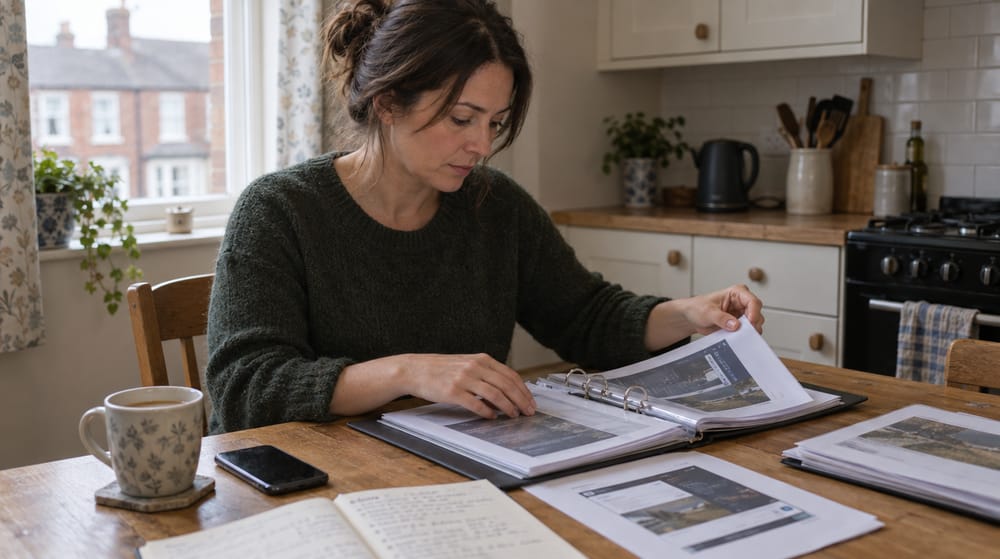
Chloe, Jake and the binder on the kitchen table
Chloe separated from Jake's dad a year ago. There had been violence early in the relationship, but nothing physical for over two years. Since the C100 was issued, the messages had started again: dozens a night, then turning up outside the house. Her question was the one on every forum: "Is this enough?"
We built her statement in date order. Two paragraphs on the past, briefly. Then the last six weeks in detail: dates, the words used, the night Jake, who is six, watched from the window. Twelve exhibits, numbered. A clear ask: no contact except through the parenting app about Jake, and not to come within 100 metres of the house.
She asked for an order without notice because the messages said he would "sort it" if she went to court. The judge made a short order and listed a return hearing. Chloe asked the court to serve the papers and asked for a video hearing. At the return hearing, Jake's dad accepted a final order without admitting the allegations. Chloe sent the order to the children case with her C1A, and the judge there set out how handovers would work.
If you have been served with a non-molestation order
This section is for the other side, because both parents read these pages.
- Obey it from the moment you know about it, even if you think it is unfair. Breaking it is a crime.
- Do not contact the other person to talk about it, and do not ask friends or family to pass messages.
- Go to the return hearing. That is your chance to respond. You can file your own statement setting out your account calmly.
- Raise contact with the children through the court, in the child arrangements case, not by stepping outside the order.
Our litigant in person's checklist helps with preparing for any hearing.
What to do this week
- If you are in danger, call 999. Then see Keeping You Safe.
- Save your evidence somewhere the other person cannot reach: screenshots with dates, photos, reference numbers.
- Write a dated list of incidents, newest last, with who saw what.
- Check legal aid, and contact RCJ Advice, Refuge, Women's Aid, Citizens Advice or the Men's Advice Line for help with the application.
- Download form FL401, the statement template and form C8, and decide whether you need to ask for an urgent order.
Quick answers
What evidence do I need for a non-molestation order?
There is no minimum. Your signed witness statement is evidence and is required with form FL401. Messages, photos, medical notes, police reference numbers, support service letters and witnesses all help, but a police report is not essential.
Can I get a non-molestation order without violence?
Yes. The court looks at all the circumstances, including the need to secure your health, safety and well-being and that of any relevant child. Threats, harassment and controlling behaviour can be relevant.
Is there a court fee for a non-molestation order?
GOV.UK says there are no court fees for applying on form FL401. You may still choose to pay for legal advice, and you may be eligible for legal aid.
Can I apply without my ex knowing?
Yes, you can ask for a without notice order. The court considers the risk of significant harm, whether you would be deterred from applying, and whether the other person is avoiding service. Your statement must explain why you have not given notice.
How long does a non-molestation order last?
It can be made for a set period or until further order. An emergency order usually lasts until the next hearing. If an order is ending and you still need protection, you can apply to extend it on form FL403 before it ends.
What happens if a non-molestation order is broken?
Call the police. Breaching a non-molestation order without reasonable excuse is a criminal offence. For an order made without notice, it only applies once the person knows about the order.
You're not alone in there
Applying for protection, or facing a return hearing?
Work With Nabila: a Case Planning Call to set out your statement and evidence clearly, a Hearing Prep Call before your return hearing or children hearing, and 6 months of membership, with the McKenzie Friend Portal and a live coaching session with Nabila every month. £450, then £99 a month only while you need it. Cancel any time.
Work with NabilaKeeping You SafeIf you are in danger, call 999. Information and support, not legal advice.- Family Law Act 1996, section 42: non-molestation orders, legislation.gov.uk
- Family Law Act 1996, section 33: occupation orders, legislation.gov.uk
- Family Procedure Rules, Part 10: applications under Part 4 of the Family Law Act 1996, justice.gov.uk
- Get an injunction if you've been the victim of domestic abuse, GOV.UK